

|
Wine spectroscopy for quality wines |


|
We suggest a method of certifying and improving the quality of wines, based on their spectroscopic monitoring through the entire manufacturing process, from grapes to the finite product.
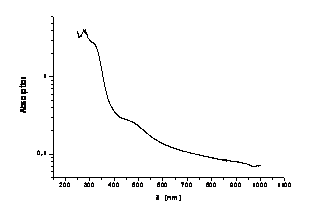
● ultraviolet / visible (UV-Vis) spectroscopy The ultraviolet / visible (UV-Vis) spectroscopy has been applied to the detection of phenolic compounds, including anthocyanins, tannins, polymer dyes and phenols form complexes with iron. Like other optical methods, analysis and identification of spectra requires the application of multivariate statistical analysis methods and correlation techniques, relatively simple and easy to perform. Unlike chromatographic methods, the spectroscopic UV-Vis technique is less selective and gives information on the composition of the total polyphenol content of wine. Although the phenolic composition can affect from the wine production and maturation conditions, differences in total phenolic fingerprint of the wine is still characteristic for each variety. The UV-Vis spectroscopy was used to determine the total phenolic extract (280nm), of flavones (320nm), the phenolic acids (360nm) and the total anthokyanidon (520nm). Some of the main advantages of this technique is that it is low cost, and measurements are made very quickly (in minutes) using a conventional spectrophotometer.
● fluorescence spectroscopy In this proposal, the fluorescence spectroscopy to analyze wine will be applied for the first time in a national level. It should be noticed, that fluorescence spectroscopic techniques are widely used as analytical tools with many applications in biology, medicine, environmental chemistry. The main advantage of this technique is its high sensitivity (low detection limits). Recently, several attempts have been made and show that this method is very promising for the identification of specific biomolecules in solutions, such as wine .
|
|
The initial work in this project is dedicated to the implementation and development of the method.
PhD position in “Implementation and development of modern spectroscopic methods for improving the quality of wine ” 3.5 years, full time position
|
|
UV-Vis absorption spectrum of red wine (ALONA -Skyloxorio variety) |

