

|
Fragmentation → collision cross section |


|
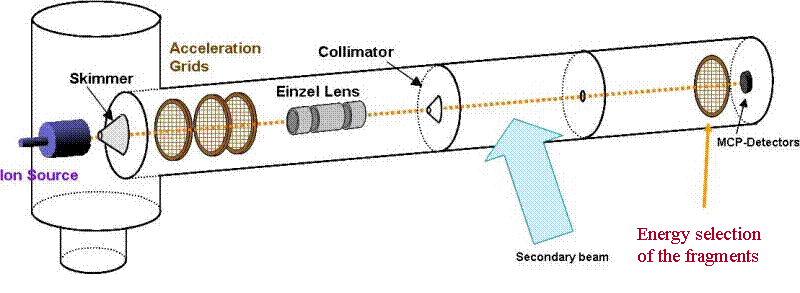
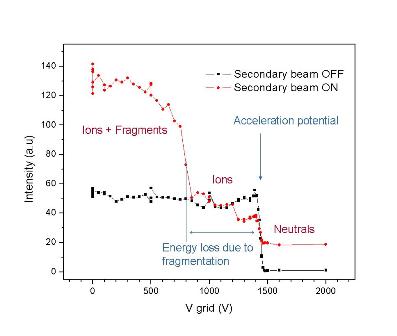
We perform collision induced dissociation studies of metal-oxide clusters and measure the fragmentation cross-section (in this case is the lower limit of the integral collision cross-section, which approximates the geometrical cross section). The geometry of a particular cluster ion is obtained by the comparison of the measured cross-section with the calculated one for a given structure. |




|
The intensity of the cluster beam interacting with the secondary beam can be described by Beer Lambert law: |
|
I0, I – the intensity of the primary beam before and after collisions s – the integral cross-section N – density of the secondary beam L – interaction length |
|
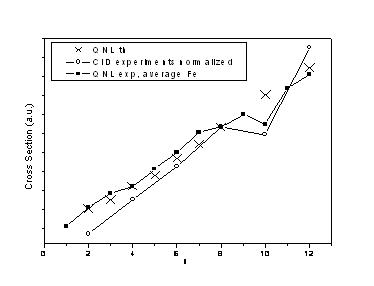
The cross section measured in this way shows excellent agreement with the theoretical results (obtained by the geometrical projection of calculated structures) and with the cross section measured by the traditional method of collision induced dissociation in a collision chamber. |

|
IN |

|
I+IN |
|
IN0 |
|
I0+IN0 |

|
IN0 = neutrals formed in the absence of the secondary beam (metastable fragmentation, background collisions, etc.) IN = neutrals formed by secondary beam scattering I0 = the intensity of the primary beam before collisions I = the intensity of the primary beam after collisions |
|
References:
Giannis Mpourmpakis , Michalis Velegrakis, Claudia Mihesan, Antonis Andriotis, “Symmetry-Switching Molecular Fe(O2)n+ Clusters “ J. Phys. Chem. A. 115 (2011) 7456
Claudia Mihesan, Michalis Velegrakis, in preparation |

