|
For release:
Dec. 8,
2005
Contacts:
Costas Soukoulis, Condensed
Matter Physics, (515) 294-2816
Saren Johnston, Public Affairs,
(515) 294-3474
AMES LAB PHYSICIST WINS
EUROPEAN UNION’S HIGHEST SCIENCE PRIZE
Costas Soukoulis Leads Team That Will Share
Portion of 1,000,000 Euro Descartes Prizes
AMES, Iowa – Costas Soukoulis, a senior physicist at the U.S.
Department of Energy’s Ames Laboratory and an Iowa State University
Distinguished Professor of physics and astronomy, coordinates the
research team that has won the Descartes Prize for Excellence in
Scientific Collaborative Research, the European Union’s highest
honor in the field of science. He and his collaborators received the
prestigious award for creating a novel class of artificial
metamaterials called left-handed materials, or LHMs, which exhibit
fascinating properties that cannot be found in naturally occurring
materials.
LHMs exhibit negative refraction, bending light in
the opposite direction to that seen in natural materials. They can
be fabricated to have zero reflectance for all angles hit by
incoming electromagnetic waves. In addition, they can focus light
without the need for curved surfaces. These and other amazing
properties promise a wide range of potential applications for
LHMs.
Soukoulis, who has also been an associate with the
research center FORTH, in Crete, Greece, since 1984, said he was
lucky to work with a top-notch team of international researchers in
creating the new subclass of materials. The team includes Professor
Sir John Pendry, Imperial College, UK; Professor Ekmel Ozbay,
Bilkent University, Turkey; Professor Martin Wegener, University of
Karlsruhe, Germany; Professor David Smith, Duke University, USA; and
Professor E. N. Economou and Dr. Maria Kafesaki, both from FORTH and
the University of Crete.
The research team was awarded the
Descartes Prize for Research in Physics at a ceremony held at the
Royal Society in London on Dec. 2. Of the 1,000,000 euro Descartes
Prize money, the team members will share 200,000 euro ($235, 634)
given for their winning project, “Extending Electromagnetism through
Novel Artificial Materials, or “EXEL.”
“Our EXEL team was
able to demonstrate the experimental reality of LHMs and their
consistency with the laws of physics,” said Soukoulis. “This
realization opened up the possibility of unprecedented applications
and devices.”
The team has already shown how the ability to focus
radio waves could lead to smaller, better-performing magnetic
resonance imaging machines for medical and biomedical diagnostics.
Numerous applications in the cellular communications industry are
also envisioned, including antennas and waveguides that are 100
times smaller and much lighter than those of today. Even slight
improvements to these types of devices can make a significant
financial impact.
Ames Laboratory Director Tom Barton praised
the work of Soukoulis and the EXEL team, saying, “It probably would
be difficult to overstate the potential importance of this historic
scientific achievement to the future of optical technology. The Ames
Lab and Iowa State University are indeed proud of the pivotal role
played by Professor Soukoulis."
Accepting the Descartes
Prize, Soukoulis paid tribute to the organizations that have
supported his research on LHMs. “I would like to express my
gratitude to Ames Laboratory and Iowa State University for
accommodating my teaching duties to allow me to also pursue research
on left-handed materials in Europe,” he said. “I would like to thank
the U.S. Department of Energy for their support during the last 20
years. Our Ames Laboratory work on photonic crystals led to the
field of negative index materials and metamaterials.”
The
Descartes Prize for Excellence in Scientific Research, now in its
sixth year, recognizes outstanding scientific and technological
results achieved through international collaborative research in
diverse disciplines. Winners are selected by a grand jury of experts
in science, industry and the general public.
Ames Laboratory is
operated for the Department of
Energy by Iowa State
University. The Lab conducts research into various areas of
national concern, including energy resources, high-speed computer
design, environmental cleanup and restoration, and the synthesis and
study of new materials.
###
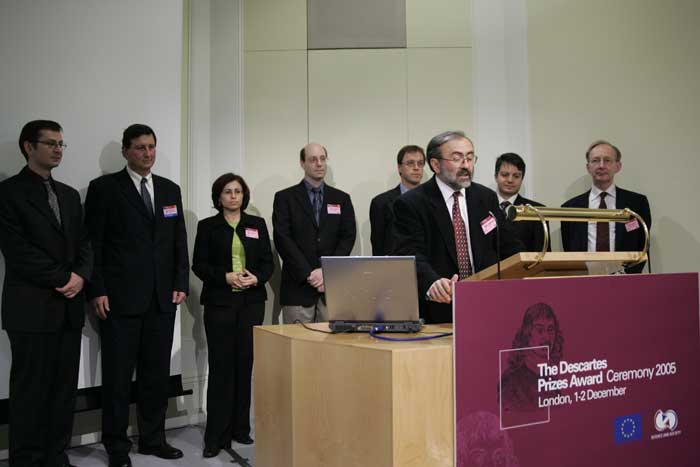
Note to reporters: Below is an image of
Costas Soukoulis at the Royal Society ceremony in London. The
caption should read:
Costas
Soukoulis accepts the Descartes Prize for Excellence in Scientific
Collaborative Research at the Royal Society in London, on Dec.
2. Members of the winning collaborative team are, left to
right: Stephan Linden (University of Karlsruhe), Mike
Wiltshire (Imperial College), Maria Kafesaki (FORTH), David Smith
(Duke University), Martin Weneger (University of Karlsruhe), Ekmel
Ozbay (Bilkent University), and Sir John Pendry (Imperial College).
Return
to 2005 Press Releases |