Dr. A. N. A N D R I O T I S
Associate
Professor in Research (EREVNITIS B')
A.2 SCIENTIFIC WORK AND ACTIVITY
FIELD OF INTEREST : Theoretical Condensed Matter Physics and Materials Research
A.2.1 Synopsis
Objectives and Constraints :
I have been exclusively employed by
Research Institutes continuously since 1979. My work is
extended to both metals and semiconductors. Despite
the fact that the frontier research in Materials becomes strongly
system dependent day after day, my work had to cover a wide range
of topics in the highly competing fields of the Theoretical
Condensed Matter Physics and Materials Research. Most of my
research work has always had specific input constraints
and specific output deliverables due to contract or/and
grant obligations.
I am in the position to
claim that, my work, on the one hand has shown remarkable
flexibility in covering different highly specialized topics,
while, on the other hand, it has been always highly
consistent with the undertaken obligations; my successful
grant proposals have been always terminated succesfully.
My major contributions include the following new theoretical methods (in chronological order) :
For a detailed description of my scientific work please see : Detailed Description of Work
Achievments in scientific work :
Our proposed model approximations have led us to develop new computational
techniques and/or ameliorate
existing techniques for studying complex systems of the condensed matter physics.
I have made a systematic development
of computational methods expanding my work to mutually supported
computational techniques and methods which are applicable to both
metals and semiconductors including bulk and
surface properties. State of the art computer codes
and methods have been developed for treating a wide range of
problems of materials science. Also, existing computer codes have
been modified/adapted according to the requirements of my work.
My vast experience with the various calculational techniques and
methods helped me in proposing and developing new calculational
schemes based either on new ideas or on the combination of highly
sophisticated methods of Condensed Matter Physics including cases
where the proposed combinations are extended to methods which had
been used in the past independently either only by physicists or
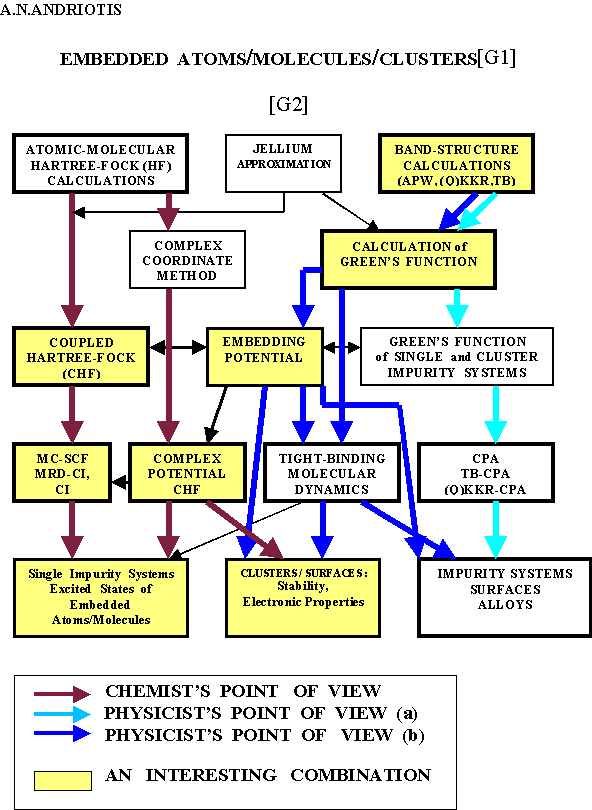
only by chemists. I have employed equally well ab initio
and semi-empirical methods which I have applied succesfully
in justifying current experimental data. (See Table for computational
methods used in the following figure.
I have published more than sixty (60) scientific papers in refereed journals, (see : List of Publications ), I have delivered more than 90 work-presentations in international and local conferences/workshops (see : List of Presentations ), and I have written two books in Computational Physics, both of which have been already published (see : Computational Physics I, II ), to be used as textbooks in my university lectures.
Organizational, Educational and Administartive Work :
At the same time, a great amount of my
work has been invested for the development of the required
background enviroment ( development of an efficient computer
center, training of senior students, teaching etc.) which is
necessary for running an efficient and proffesional
research in materials physics. This requirement becomes more and
more demanding as the materials research gets system specific and
requires highly trained personnel. I can claim that, during my
last twelve years at IESL/FORTH and as an adjunct ( or law 407)
professor at the University of Crete, (UC),